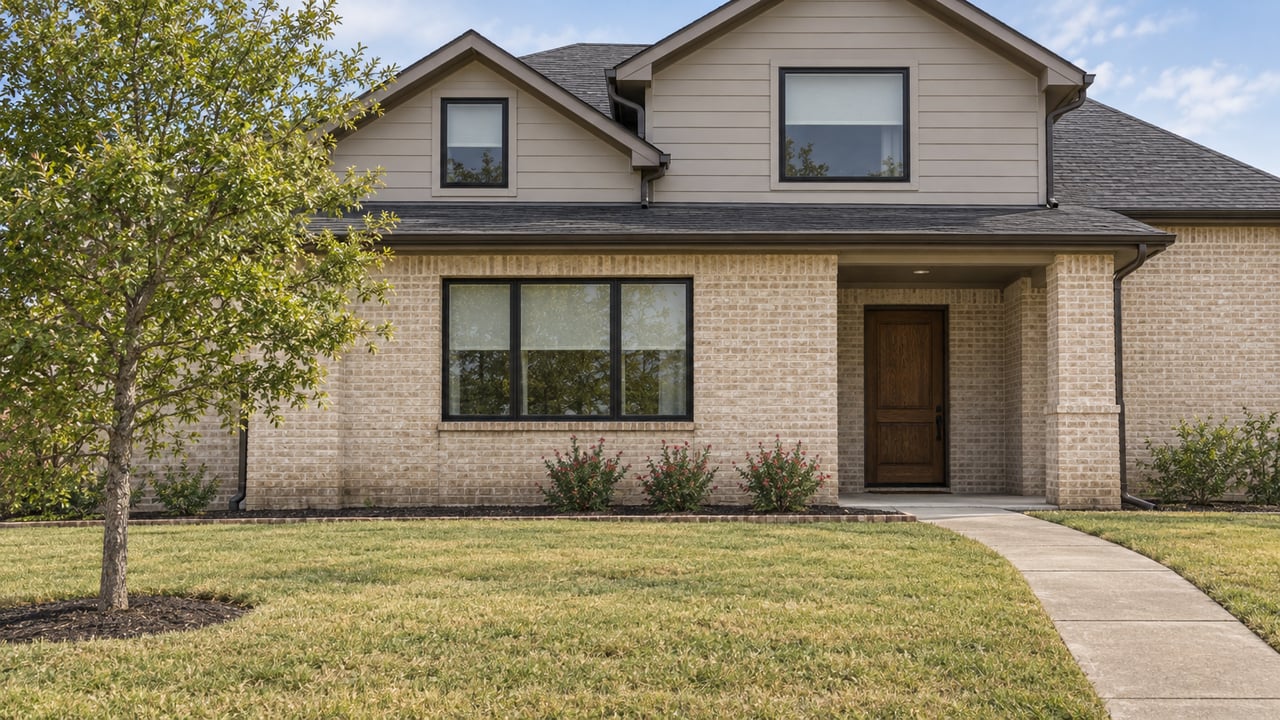
Two homes in The Oaks in Red Oak can each sit on a 50-foot lot, in the same subdivision and the same special district, and still carry yearly assessment bills that differ by close to a thousand dollars. The City of Red Oak's 2026 Amended and Restated Service and Assessment Plan for Red Oak Public Improvement District No. 1 lists a 50-foot lot in Improvement Area 1 at $1,076.70 for the installment due January 31, 2027. The same plan estimates the average yearly installment for a 50-foot lot in Improvement Area 2 at $2,054.10.
That gap is new. On September 14, 2026, the Red Oak City Council levied assessments on the subdivision's second and third improvement areas and approved the bonds that pay for them. For anyone comparing homes in The Oaks this fall, the property ID now tells you more about carrying cost than lot width does.
The Paperwork That Shows the Difference
Texas puts the existence of the assessment in front of buyers before they sign. Texas Property Code §5.014 requires a seller conveying property inside a PID to give the purchaser a written notice. The notice identifies the property, the city or county that levied the assessment, the district, the assessment obligation and the improvements it pays for. The notice has to arrive before a binding contract. The buyer signs to acknowledge it, and a separate current notice is signed and recorded at closing.
The statutory language also explains how the obligation behaves. The assessment can be paid in full at any time. Otherwise, the annual installments can change with interest and with collection, administrative and delinquency costs. Nonpayment can lead to penalties, a lien and foreclosure.
The notice tells you a home is assessed, and the statute says the exact amount can be obtained from the municipality. To see why two homes on the same street width get different figures, you need the city's assessment plan.
The Same Lot Width Across Five Lot Types
The 2026 plan splits The Oaks into five lot types across three improvement areas. Improvement Area 1 holds 50-foot and 62-foot lots. Improvement Area 2 holds 50-foot and 62-foot lots too, and Improvement Area 3 holds 74-foot lots. Here is how the plan's own figures line up.
| Area and lot | Lots | Estimated buildout value | Principal assessment per lot | Yearly installment per lot |
|---|---|---|---|---|
| Area 1, 50-foot | 167 | $293,750 | $14,307.51 | $1,076.70 due 1/31/2027 |
| Area 1, 62-foot | 156 | $364,250 | $17,741.32 | $1,335.11 due 1/31/2027 |
| Area 2, 50-foot | 242 | $475,000 | $23,938.80 | $2,054.10 estimated average |
| Area 2, 62-foot | 22 | $550,000 | $27,718.61 | $2,378.43 estimated average |
| Area 3, 74-foot | 66 | $600,000 | $29,393.94 | $2,587.56 estimated average |
The Area 1 installments come from the actual assessment roll for the January 2027 payment. The Area 2 and Area 3 figures are the plan's average annual installments. They are estimates, and the plan says installments can change with each annual update.
Put the two 50-foot rows side by side and the Area 2 lot is estimated at about $171 a month, compared with about $90 a month for the Area 1 lot. On the 62-foot lots, the gap is a little over $1,000 a year.
Why the Bill Follows the Phase
The plan spreads each improvement area's costs across its lots in proportion to each lot's estimated buildout value. In other words, the district assumes a home's value and charges against that assumption. The plan pegs Area 1's 50-foot lots at $293,750. Area 2's 50-foot lots are pegged at $475,000. Width is the same. The assumed value is not, and the bill follows the assumed value.
The second driver is when each phase was financed. Improvement Area 1 was funded with the City of Red Oak's Series 2021 special assessment revenue bonds. Areas 2 and 3 are funded by an $8,343,000 Series 2026 bond. At the September 14 meeting, Hilltop Securities described it as a 6.39% fixed rate over 30 years, assessed across 330 parcels, with an average homeowner installment estimated at $2,182 and the first payment due in January. The council record notes that the bonds are secured by the assessments only. Citizen Portal's write-up of that meeting adds that the bond pays for improvements in the Oaks subdivision and reimburses the developer for part of the project costs.
The plan also states the burden as a tax rate equivalent, meaning the yearly installment expressed per $100 of estimated value. Improvement Area 1 was set at $0.3597 per $100 when the 2021 assessment ordinance passed. Area 2 sits at $0.432442 and Area 3 at $0.431259. So the newer phases carry higher assumed values and also pay more on each dollar of that value.
Stacking It on the 2026 Tax Rates
A PID installment comes on top of ordinary property taxes. For tax year 2026, the City of Red Oak adopted $0.695 per $100. Red Oak ISD's rate notice lists $1.0492. The Waxahachie Sun's rate table, which covers rates adopted and reported as of October 13, lists Ellis County at $0.255787.
Those three come to about $2.00 per $100. Here is the comparison on a 50-foot lot using the plan's own figures:
- Area 1, 50-foot lot: a PID equivalent of $0.3597 adds roughly 18% on top of the three main rates, and the January 2027 installment is $1,076.70.
- Area 2, 50-foot lot: a PID equivalent of $0.432442 adds roughly 22%, with an estimated average installment of $2,054.10.
- The dollar gap: about $977 a year between two lots of the same width.
A particular home's tax bill depends on its appraised value, its exemptions and any other taxing units on that parcel. The PID figures above come from the city's plan and don't depend on the appraisal.
Reading a Builder Discount Against a 30-Year Bill
Buyers touring The Oaks this fall will see Bloomfield Homes, whose community page names Red Oak Public Improvement District No. 1 and refers PID questions to the community manager. HistoryMaker Homes also markets a Red Oak community called The Oaks, at 725 Rainer Court, with homes listed from the $340s to the $500s. Its fall promotion advertises limited-time price cuts of up to $100,000 on select inventory and lists The Oaks as a participating community.
A price cut happens once, at closing. A PID installment comes every year for the life of the assessment, and the Series 2026 bond runs 30 years. When you compare a discounted new build in one phase with a resale home in another, the yearly installment for that specific property ID belongs in the same calculation as the purchase price.
The plan also lets the owner of any assessed property prepay the assessment. The rules for full and partial prepayment are spelled out in the plan, and the outstanding principal on each lot is listed on the roll. For an Area 1 50-foot lot heading into the January 2027 payment, the roll shows $14,307.51 outstanding.
FAQ
Is The Oaks one PID or three? It is one district, Red Oak Public Improvement District No. 1, split into three improvement areas, each with its own assessments. Area 1 has 323 single-family lots. Area 2 is planned for about 264 lots and Area 3 for 66.
When are the first Area 2 and Area 3 installments due? Hilltop Securities told the council the first payment is due in January, and closing on the bonds was expected September 30.
Can a lot's installment change from year to year? Yes. Both the state notice and the city's plan say installments can vary, and the city updates the plan every year.
This post is general information, not legal, tax or financial advice. Please confirm the assessment and tax picture for any specific property with the right professional before you make an offer.
If you're comparing homes across the phases of The Oaks, the Krissy Mireles Team can help you line up the PID notice, the property ID and the lot's line on the city's assessment roll in hand before you sign, so you can weigh the yearly installment alongside the price. Let's talk about your next move.
